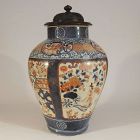
A massive imari vase with decoration of the Genroku era of bijin (a beauty) and hana (flowers) on two opposing panels alternating with two more opposing panels of a structure (tea house?) in garden landscape - all in red, gold and black enamels with blue underglaze. Similar landscape decorated panels appear on the shoulder over a ground of hanabishi (flowery diamond) in repeating diamond bordered pattern. The hanabishi (sometimes also referred to as karabana, or 'Chinese flower') could be representative of a ka-mon (family crest). The prominent Takeda family and its branches used the hanabishi ka-mon onward after the Heian period. The Genroku era spanned from 1688 to 1704. The arts and luxuries reached their apex during this era of the Edo period - contributing to large, opulent expressions such as the present vase. Genroku style and influence continued for a short time after (as could this vase) while the Tokugawa Shogunate struggled with inflation after devaluing coin quality in an attempt to sustain the appearance of prosperity (sound familiar?) So in some ways the Tokugawa followed in the footsteps of the decadent Ashikaga. Good, stable condition save an old crack through the foot rim which might originate with the firing as a crazing pattern conforms along and around the crack as if from excessive heat (limited to inside the foot and the lower portion of one bijin panel.) Vase height (not including cover) is 15 7/8 inches (40.32 cm)
This vase is accompanied by a Chinese, late Qing dynasty, exquisitely carved hardwood cover. The fit is loose and the cover a bit small proportionately. As they did not start life together, we are amenable to selling the cover separately should someone have a need. The cover would best fit a large vase with interior rim diameter of no smaller than 4 9/16" (11.58 cm). The cover is 7 5/16" (18.57 cm) with the wood grain (there is substantial shrinkage of the wood against the grain with age.) The cover is in presentable condition with some glue evidence on the interior - probably from refitting after shrinkage.
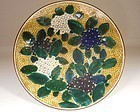
An Ao-Kutani palette porcelain deep dish in the Yoshidaya manner. Hydrangeas decoration in polychrome enamels including white, light blue-green, and dark green, blue, blue-green and aubergine in black line, all on yellow ground, a chocolate brown enamel on the otherwise unglazed biscuit rim. The number and subtlety of hues but consistent for palette is pleasing. The back with enamels including dark green on black line decoration of clouds. Kutani mark in black under yellow glaze inside the foot ring which appears to have been glazed but with the enamel rubbed along high points to the porcelain body. A couple of kiln kisses to the cloud decoration area on the back. The so called Yoshidaya type of 19th century Ao-Kutani wares is named for a merchant who revived production of a particular palette of Ko-Kutani production (of the 17th and early 18th century) adjacent to the original kilns. The current example certainly appears to be 19th century and could possibly be from the Yoshidaya kiln. Later Ao-Kutani palette production is often ambitiously ascribed to the Yoshidaya kiln which, in fact, operated only briefly from the 1820s to the early 1830s. One 3/16 inch flake (mostly to the enamel) under the rim. Otherwise good condition considering expected scratching and rubbing of the enamel. Presents well. Diameter, 11 7/8 inches (30.16 cm)
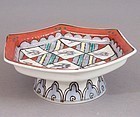
A fine, modern footed dish with red, green and yellow overglaze and with cobalt blue and manganese underglaze decoration. The hexagonal, everted rim with red border defining a cloud band around conforming hexagonal cavetto with chidori (sparrows) alternating with polychrome squares - borders of decoration all picked out with manganese (giving an iron effect but fading nicely into the blue decoration rather than spoiling it with fade to brown. The splayed foot with a cloud pattern in modern interpretation of the Nabeshima tradition. As we describe this unusual object, it should become more apparent that it is rather substantial (though small, sturdy potting) and not commercial production. The dish - top and bottom - as well as the foot retains impressed decoration and texture in the porcelain over which the decoration was added with deference... the blue glaze, for example, lightly filling the recesses of, perhaps, a hemp impression over a more broadly ridged surface and leaving the highpoints almost white. The same molded and impressed texture can be felt top and bottom of the dish and the cloud pattern on the foot can also be felt when running one's finger along the decoration. The unglazed foot rim reveals a fine, white kaolin with smooth feel to the touch. Unfortunately, though the molded and impressed decoration rather nicely retained texture, a square impressed mark inside the foot did not and offers no legible mark. We are comfortable proposing an attribution to Hajime Kato (1900 - 1968) but can not make any definitive claim and estimate accordingly. Perfect condition. Diameter, point to point, 6 3/4 inches (17.145 cm). Height, 2 1/4 inches (5.715 cm)
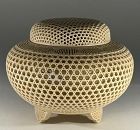
A very finely made Satsuma alms bowl form kōro (incense burner). Clear glaze pooling to a light, warm green tea tone over the off-white earthenware body. The reticulated surface of the vessel enclosing a smaller, solid surface to hold burning incense (a technical feat demonstrating the imagination and skill of the potter). Relief key fret band around the rim and comb pattern around the base. Similar relief decoration on three shaped feet. The cover a single reticulated surface allowing essence from the incense to pass. An unglazed ring on the bottom, centered within the three feet, surrounding a smooth surface where at least two incised kanji characters are almost legible under the glaze near one of the feet. With fitted wood box, the cover inscribed ‘Satsuma [?] kiln, basket weave incense burner’ and signed ‘Gyokumeizan’ (a celebrated line of ceramists), each with seal stamps. “Satsuma” is the old name of the province and the namesake of its ceramic tradition. We are not sure if “Satsuma” on the box is reference to a municipality or a market enterprise (as the trailing kanji character could be the same for ‘city/town’ or for ‘market’). We believe this tour de force to be about Taishō era. Condition is good. The reticulated work of the top has one tiny surface loss which does not disrupt the pattern and is barely discernible. The side of the vessel has one spot of thicker glaze softening the definition of the reticulation with opacity at that point. Diameter, about 5 inches. Height (covered), about 4 inches.
Ex collection, Robert Berg (Ichiban Antiques)
Ex collection, David Callens (Meiji Bijutsu)
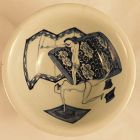
A well made 19th century Japanese porcelain haisen (sake up rinser on stem foot). Rare Shunga decoration depicting a bondage scene within the bowl. The manner of the painted decoration in comic fashion similar to that found on some shunga makimono. Shunga paintings and prints are rare enough but encountered. Edo period porcelains with shunga decoration are exceedingly rare. Good condition. Height, 4 1/2 inches. Diameter, 6 3/4 inches.