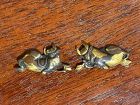
A pair of Japanese, Edo period, copper alloy menuki depicting buffalo. Horns, hooves and spots highlighted with gold hirazogan overlay. Good condition. Each about 1 1/8 inches.
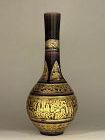
A fine Meiji or Taisho period Eiraku kiln aubergine glazed porcelain vase. Rubbed gilt enamel highlights over archaistic relief decoration in manner of the Eastern Zhou dynasty or Western Han dynasty. The vase, with base reminiscent of the Hu form but with elongated neck, harmoniously combines modern and ancient design sense. The blank apparently two symmetrical halves, joined (see closeup images revealing raised glaze where a seam might be). Eiraku seal mark on the foot. Good condition. Height, 9 7/8 inches.
The venerable Eiraku line of potters doesn’t commonly come to mind when one thinks of Japanese studio ceramics, but one can readily see creative Edo and early Meiji examples preceding comparable works by the later Meiji era greats. Examples of inspired Eiraku kiln porcelains with gilt enamel, pushing the limits of their time, can be found in museum collections and in auction sale records.
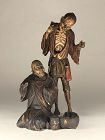
Edo period lacquered wood sculptural figural group of a Buddhist monk and an emaciated figure. Upon first consideration, this may represent Mukaku (a monk) and Seshin (an ascetic) - two Bodhisattvas associated with Buddhist teachings, particularly in Japan. But an inscription on the back appears to reference Dai Nichi[ren?]. As Nichiren would suggest use of Gohonzon (abstract representations, such as prayer incantations) rather than idols, this representation of a symbolic parable (instead of a figure of devotion) may make sense. In other words, this object may have been one of veneration rather than worship. In this case, Nichiren may be associated with the virtues of Mukaku. Note the realism in the depictions, including expression, anatomy and color. The seated monk’s head can be repositioned for effect. Echoes of the Kei school of Buddhist sculpture can be felt - particularly from the open mouth of the standing ascetic, as if issuing some sage expression. Crystal eyes, also an innovation of the Kei school, are used here, though mostly covered with patina. An unusual and rare object. Probably 18th century. Losses to the seated monk’s hands and some distress to the lacquered surface, otherwise good condition. Overall height, about 17 1/2 inches
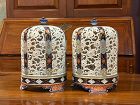
A very rare pair of finely modeled and decorated Imari reticulated, lantern form porcelain candle domes. Blue underglaze and polychrome enamel decoration with very pale celadon pooling in the clear glazed areas. This extraordinary find is made only more so by coming in a pair. The only similar objects I initially find include an Hirado censer (in two parts) in the Los Angeles County Museum of Art (M.2003.154.25a-b) and another, “Seto” example in the Victoria and Albert Museum (172&A-1877), both early 19th century. I think one will not find another. It is not improbable that the blanks, well decorated in Imari palette, may be Hirado production by special order. This is consistent with the intricate open worked flowering vine decoration as well as the feel of the unglazed biscuit around the bottom aperture. A cobalt blue band with apparently Japanese family Mon in white adorns the bottom above three, shaped feet. With this, it becomes less clear whether these were intended for domestic consumption or (more likely) for export. 19th century. One is in very good condition. The other is also fully serviceable and sound though with an old stress line on the bottom rim (see enlargement views). That one is 11 1/4 inches high. The other is 11 1/2 inches high.
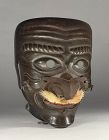
An early Edo period iron Sōmen (full face mask). The nose is a replacement from the same material, period and school. As the nose is interchangeable by design, this is not objectionable and priced accordingly. As part of a samurai’s armor, a Sōmen would provide greater protection than a menpo. This Sōmen is lighter than later, fanciful Edo period “parade” examples.
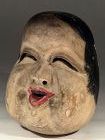
Japanese, Edo period, carved and painted wood Noh mask. Depicting Otafuku (popularly known as Okame), boldly and adeptly carved with full, deep, expressive features. Painted white all over, blackened teeth as was the custom, red lips, and black hair in distinct, fine brush strokes for affect. The hollowed out verso displaying the tool marks of the unknown artisan. Surfaces moderately distressed and with much patina from use and handling. Length, 8 1/4 inches.
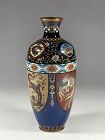
A well made Japanese cloisonné vase. The alternating dragon and phoenix chevron panels symbolize harmony and balance. Areas of flower, vine and pendant decoration. Lots of engaging, balanced color. Sparkling goldstone embellishment technique demonstrated in dark green background on the shoulder. Some interesting areas of mottled color enamel details. Meiji era (1868 - 1912). Very good condition. Height, about 7 1/4 inches (18.4 cm)
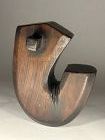
A carved keyaki (zelkova) wood Ebisu style Jizai-Kagi (pot hanger suspended over a home’s hearth). Ebisu was one of the seven gods of good fortune and this form is thought to resemble his hat. Good examples are sought after works of folk art. The well conceived shape and proportions of the present example, as well as its acquired patina, is attractive and the condition good and serviceable. Minor abrading of wood surface. 19th century. Somewhat on the small side at almost 10 inches, it is also therefore easily used in decorating.
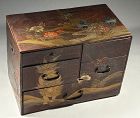
A well made and complex burl keyaki wood box of drawers and compartments. Compartments and drawers well suited to hold inkstone, colors, paper, brushes, works and accessories. Nice, handmade hinges and drawer hardware. Painted decoration of Shishi among peonies - nicely done in a charming, mingei (folk art) manner and likely by a previous owner of this kodansu. Late Edo period. There is expected wear from use, movement and checking of wood, and minor losses to the polychrome lacquer decoration. Otherwise an attractive and intriguing furnishing in serviceable condition. Length, 13 3/4 inches. Height, 10 inches. Depth, 8 inches.
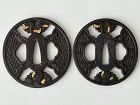
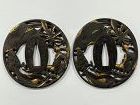
Daisho Bushu school iron tsuba. Sukashi decoration of basket weave panels and parcel gilt prunus blossoms. Each signed Bushu Ju Masanaga. A nice pair of tsuba having started life together. Edo period. Good condition. Larger, 2 7/8 by 2 3/4 inches. Smaller, 2 3/4 by 2 5/8 inches.
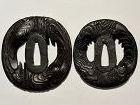
A fabulous pair of daisho iron tsuba. Haruta school, with the character “Haru” still legible in the seppa-dai of the larger. Realistic depiction of weathered wood with a few gin-zogan (inlaid silver) woodworms in the decoration of the larger. I’ve seen similar work attributed to Hirata school, but that must have been misheard from Haruta. Excellent condition, and the two having started life together. Later Edo period, early 19th century. Larger 3 1/8 by 2 15/16 inches. Smaller, 2 13/16 by 2 5/8 inches.
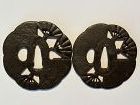
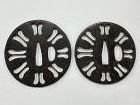
A pair of daisho iron tsuba of yatsu-mokko-gata (eight lobed) form. Sukashi motif of fans and gingko leaves (an interesting combination of similar shapes). Some chiseled texturing of the surfaces of the gingko leaves. Edo period, circa 1700. Good, serviceable condition with a few interrupted fan ribs on the larger. It is about 3 1/8 inches diameter. The smaller is about 2 7/8 inches diameter.
Two finely carved and parcel gilt iron tsuba. Each signed Choshu Hagi Ju Sakunoshin Tomohisa. Decoration of pine cone, gingko leaf, maple leaf and oak branch with leaves and acorns. This is also a known Bushu school motif. Edo period. Good condition. One 2 15/16 inches by 2 13/16 inches. The other 3 by 2 3/4 inches. Offered as a pair as they would work perfectly for daisho with a stout wakizashi, but we will entertain interest in just one as well.
A fine pair of Chosho school maurugata form iron daisho tsuba. Sukashi work depicting blossoms on budding prunus branches. Strongly and well carved decoration. Edo period, 18th century. Good condition, with the nakago-ana filed larger at some point. Larger, 3 1/8 diameter. Smaller, 2 7/8 by 2 13/16 inches.
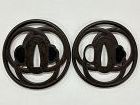
A fine daisho pair of Akasaka school iron sukashi tsuba. The concentric rings motif reminds of kamon designs but also could be symbolic of the rings on a Buddhist monks prayer staff. Very good spatial design consistent with earlier, sophisticated yet austere samurai taste. These started life together for use on the long and short sword pair. Circa 1700. Excellent condition and consistent as a pair in all respects. Larger, 2 15/16 by 2 7/8 inches. Smaller, 2 13/16 by 2 3/4 inches.
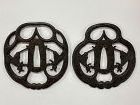
A matched pair of iron tsuba. Wasp and antler motif. Relates to a Japanese saying (we’ll research and get back with an account). Not a true daisho pair, the workmanship and subject are more than just close enough to appropriately use well on daisho swords. Edo period Shoami work, circa 1800. I’ve also seen this motif attributed to Kanayama (the surface texture would be consistent). There could be overlap as Shoami was more a movement than a region-bound school. Good condition. Comparable dimension for each, about 3 1/4 inches high by 3 1/8 inches wide. One round and spatially larger.
Daisho ko-Shoami marugata form (round) tsuba. Gunbai-uchiwa motif (gunbai referring to a war signal fan and uchiwa referring to the form of the fan). A pair being understood as a daisho (though one tsuba being for the longer of two swords, and the other for the shorter sword, they are more often than not graduated in size). These started life together. It also being understood that a ko-Shoami tsuba would be iron - the Shoami tsuba movement issuing from armor makers and “ko” (old) relating these tsuba to earlier in that movement. Good, simple, Samurai taste of the late Muromachi era. 16th century. Good condition. Larger, between 3 1/8 and 3 3/16 inches diameter. Smaller , between 2 7/8 and 2 15/16 inches diameter. Thickness each, about an 18th inch.
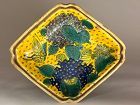
A set of five Ao-Kutani palette rhombus form mukozuke. Hydrangea and butterfly decoration in blue, teal, chartreuse, aubergine and yellow enamels. The verso with chidori and waves in green outside the foot and yellow with green Fuku mark inside the foot. Uncommon to encounter an original set of five still together. Good condition with varying states of kiln residue. Probably mid 19th century (post Yoshidaya). Each length just over 7 inches. Each width just over 6 inches. Each height from foot just over 1 inch.