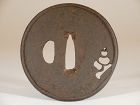
An armorer's iron tsuba, possibly for a wakizashi as it is somewhat diminuitive in size. Or perhaps more in keeping with its apparent age, an early example of a proportionately small tsuba used with an uchigatana as was first the fashion. Sukashi decoration of a conch (horagai) traditionally used for ritual practices and for signaling on the battlefield. The rare uchikaeshi-hineri rim (mimi) is significantly raised and defined almost as if to suggest a separate piece of iron around the rim (though it is one with the plate.) Though the small sukashi might suggest tosho (swordsmith), the distinct and high rim clearly indicates ko-katchushi (old armorers) work. Good condition with tekkotsu, dark patina and some inert, brown surface rust for which we are lightly applying oil when dry (we prefer not to overclean or dry out a tsuba so will not take some of the more invasive measures against only light rust.) This tsuba has an early feel - perhaps early Muromachi. 2 3/4" (7 cm) marugata. The thickness of the plate is about 1/8" (.32 cm). The thickness at the rim is about 1/4" (.63 cm)
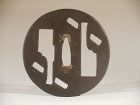
A katchushi (or armorer's) tsuba, probably Myochin, with pierced decoration of ship's rudders (the significance being a comparison of rudders steering a ship to values guiding a Samurai's life choices.) The strong, homogenous, dense iron plate with only light tekkotsu and smooth to the touch. Dark patina. Momoyama to early Edo. Good condition: Lamination folds with openings evident on the surface of one side. Ex Skip Holbrook collection. 3 3/32" x 3 1/16" x 1/8" (7.8 cm x 7.7 cm x .32 cm)
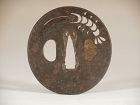
An armorer's tsuba, with very slightly raised rim on the strong, flat iron plate. Pierced decoration of a shrimp with pleasing, subtle swell along the antennae and legs (mostly on the ura.) Small, irregular brass inlays for the eyes (missing from one eye - not conspicuous.) The kogai-ana plugged with a copper rich alloy. Oval form about 2 7/8" (7.3 cm) by 2 3/4" (6.985 cm). Thickness at rim about 5/32" (.39 cm). Late 16th century to early 17th century - perhaps Momoyama period. Or possibly earlier with hitsu-ana added (though old). Good condition with varieagated hues in the dark, lustrous patina likely with extant lacquer adhering and accounting for some of the black color (note that the tsuba has an overall dark, mottled patina which our lighting doesn't adequately portray). Subtle tekkotsu evident - some old, worn pitting with the surface now smooth, almost soapy to the touch.
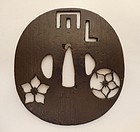
The Katchushi style of this tsuba gives it an earlier look and feel. But it is probably an Edo period work (might expect more wear on the seppa-dai or more conspicuous tekkotsu on an older example.) The thin body nonetheless resilient. Strong, sparse, decorative file marks on the vertical add to character. Adept use of the file, thin plate and slight taper toward the rim could support argument a swordsmith may have made the tsuba. Genji style mon and two five petal blossoms in fine open work (some iron detailing missing from one of the blossoms, the other with one of the open worked petals interrupting the rim.) Smaller kozuka-ana and kogai-ana flanking the seppa-dai. The surface smooth to the touch despite some old, light pitting. Possible scant old lacquer adhering closely to the surface (difficult to discern with certainty as some hard wax appears to have been applied to the surface.) Simple sukashi tsuba are considered by many to be closest to Samurai taste. Fine open work and subtle attention to detail such as the file work add to appeal. Length, 3 9/32 inches (8.33 cm). Width, 3 1/16 inches (7.78 cm). Thickness, about 3/32 inch (0.238 cm)
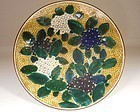
An Ao-Kutani palette porcelain deep dish in the Yoshidaya manner. Hydrangeas decoration in polychrome enamels including white, light blue-green, and dark green, blue, blue-green and aubergine in black line, all on yellow ground, a chocolate brown enamel on the otherwise unglazed biscuit rim. The number and subtlety of hues but consistent for palette is pleasing. The back with enamels including dark green on black line decoration of clouds. Kutani mark in black under yellow glaze inside the foot ring which appears to have been glazed but with the enamel rubbed along high points to the porcelain body. A couple of kiln kisses to the cloud decoration area on the back. The so called Yoshidaya type of 19th century Ao-Kutani wares is named for a merchant who revived production of a particular palette of Ko-Kutani production (of the 17th and early 18th century) adjacent to the original kilns. The current example certainly appears to be 19th century and could possibly be from the Yoshidaya kiln. Later Ao-Kutani palette production is often ambitiously ascribed to the Yoshidaya kiln which, in fact, operated only briefly from the 1820s to the early 1830s. One 3/16 inch flake (mostly to the enamel) under the rim. Otherwise good condition considering expected scratching and rubbing of the enamel. Presents well. Diameter, 11 7/8 inches (30.16 cm)
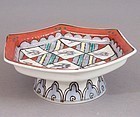
A fine, modern footed dish with red, green and yellow overglaze and with cobalt blue and manganese underglaze decoration. The hexagonal, everted rim with red border defining a cloud band around conforming hexagonal cavetto with chidori (sparrows) alternating with polychrome squares - borders of decoration all picked out with manganese (giving an iron effect but fading nicely into the blue decoration rather than spoiling it with fade to brown. The splayed foot with a cloud pattern in modern interpretation of the Nabeshima tradition. As we describe this unusual object, it should become more apparent that it is rather substantial (though small, sturdy potting) and not commercial production. The dish - top and bottom - as well as the foot retains impressed decoration and texture in the porcelain over which the decoration was added with deference... the blue glaze, for example, lightly filling the recesses of, perhaps, a hemp impression over a more broadly ridged surface and leaving the highpoints almost white. The same molded and impressed texture can be felt top and bottom of the dish and the cloud pattern on the foot can also be felt when running one's finger along the decoration. The unglazed foot rim reveals a fine, white kaolin with smooth feel to the touch. Unfortunately, though the molded and impressed decoration rather nicely retained texture, a square impressed mark inside the foot did not and offers no legible mark. We are comfortable proposing an attribution to Hajime Kato (1900 - 1968) but can not make any definitive claim and estimate accordingly. Perfect condition. Diameter, point to point, 6 3/4 inches (17.145 cm). Height, 2 1/4 inches (5.715 cm)
Pair of Niō guardian figures in forbidding pose. Vigorously sculpted wood with remnants of distressed polychrome pigments. Later Edo period - probably first half of the 19th century. The sculptures are in fair, presentable condition though polychrome pigments are distressed and loose. With some checking and movement of the wood to be expected, there is a larger crack in the lower half of one figure. Standing about 22 inches including the bases, add another few inches for the blade held high by one of the figures.
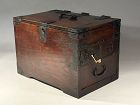
An Edo period kake-suzuribako (scroll calligraphy box). Iron hardware all in place. Lock face and key but lock works mostly gutted. Original tray with liner retained. Wood surface naturally distressed from use but with expected, even patina with all the accompanying charm. A smoothly finished zelkova (keyaki) may be used for the primary wood, and sugi (cedar) for the aromatic secondary wood. Length, 14 1/4 inches. Depth, 9 1/2 inches. Height, 9 3/4 inches.
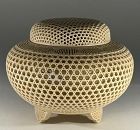
A very finely made Satsuma alms bowl form kōro (incense burner). Clear glaze pooling to a light, warm green tea tone over the off-white earthenware body. The reticulated surface of the vessel enclosing a smaller, solid surface to hold burning incense (a technical feat demonstrating the imagination and skill of the potter). Relief key fret band around the rim and comb pattern around the base. Similar relief decoration on three shaped feet. The cover a single reticulated surface allowing essence from the incense to pass. An unglazed ring on the bottom, centered within the three feet, surrounding a smooth surface where at least two incised kanji characters are almost legible under the glaze near one of the feet. With fitted wood box, the cover inscribed ‘Satsuma [?] kiln, basket weave incense burner’ and signed ‘Gyokumeizan’ (a celebrated line of ceramists), each with seal stamps. “Satsuma” is the old name of the province and the namesake of its ceramic tradition. We are not sure if “Satsuma” on the box is reference to a municipality or a market enterprise (as the trailing kanji character could be the same for ‘city/town’ or for ‘market’). We believe this tour de force to be about Taishō era. Condition is good. The reticulated work of the top has one tiny surface loss which does not disrupt the pattern and is barely discernible. The side of the vessel has one spot of thicker glaze softening the definition of the reticulation with opacity at that point. Diameter, about 5 inches. Height (covered), about 4 inches.
Ex collection, Robert Berg (Ichiban Antiques)
Ex collection, David Callens (Meiji Bijutsu)
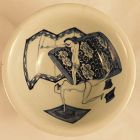
A well made 19th century Japanese porcelain haisen (sake up rinser on stem foot). Rare Shunga decoration depicting a bondage scene within the bowl. The manner of the painted decoration in comic fashion similar to that found on some shunga makimono. Shunga paintings and prints are rare enough but encountered. Edo period porcelains with shunga decoration are exceedingly rare. Good condition. Height, 4 1/2 inches. Diameter, 6 3/4 inches.
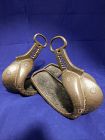
Probably Echizen province, late 16th or 17th century. Bizen province artisans also took up Yoshiro zogan inlay work in the Kinai (ancient provinces and surrounds) manner. Brass (valuable in the period) and silver inlay flush with the iron surface was thought to have been introduced by an artisan named Yoshiro, for whom it is named. Slightly earlier, Heianjo school work tends to rest atop the surface into which it is inlaid. Late Muromachi or early Edo period. Length, about 12 inches. More pictures coming