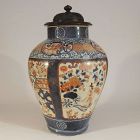
A massive imari vase with decoration of the Genroku era of bijin (a beauty) and hana (flowers) on two opposing panels alternating with two more opposing panels of a structure (tea house?) in garden landscape - all in red, gold and black enamels with blue underglaze. Similar landscape decorated panels appear on the shoulder over a ground of hanabishi (flowery diamond) in repeating diamond bordered pattern. The hanabishi (sometimes also referred to as karabana, or 'Chinese flower') could be representative of a ka-mon (family crest). The prominent Takeda family and its branches used the hanabishi ka-mon onward after the Heian period. The Genroku era spanned from 1688 to 1704. The arts and luxuries reached their apex during this era of the Edo period - contributing to large, opulent expressions such as the present vase. Genroku style and influence continued for a short time after (as could this vase) while the Tokugawa Shogunate struggled with inflation after devaluing coin quality in an attempt to sustain the appearance of prosperity (sound familiar?) So in some ways the Tokugawa followed in the footsteps of the decadent Ashikaga. Good, stable condition save an old crack through the foot rim which might originate with the firing as a crazing pattern conforms along and around the crack as if from excessive heat (limited to inside the foot and the lower portion of one bijin panel.) Vase height (not including cover) is 15 7/8 inches (40.32 cm)
This vase is accompanied by a Chinese, late Qing dynasty, exquisitely carved hardwood cover. The fit is loose and the cover a bit small proportionately. As they did not start life together, we are amenable to selling the cover separately should someone have a need. The cover would best fit a large vase with interior rim diameter of no smaller than 4 9/16" (11.58 cm). The cover is 7 5/16" (18.57 cm) with the wood grain (there is substantial shrinkage of the wood against the grain with age.) The cover is in presentable condition with some glue evidence on the interior - probably from refitting after shrinkage.
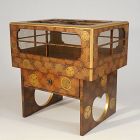
This is one of the more intriguing lacquer objects we have owned. Adorned with maki-e Aoe (hollyhock) Ka-mon on nashiji ground (also known as the Kamo Aoi as it was sacred to the Kamo shrine), family crest for prominent daimyo families including the Tokugawa and the Matsudaira during the Momoyama and Edo periods. Even the drawer pull is fashioned as an open worked shibuichi Aoe Ka-mon with the surprise of a textured, kinko (soft metal) raised backing only if you look for it. More interesting yet is the unusual form of this object - perhaps an only opportunity to acquire an example. Resembling a food tray on stand, it nonetheless has a drawer (not common to the form.) And a tall cover comes with a screen (silk?) as if to permit viewing whilst keeping something either in or out. We have not found another example of the form and so are not certain if it might be a covered dining tray (though the drawer) if intended to keep bugs out. Or perhaps it is in fact an insect terrarium (someone suggested it might be a large "cricket cage" or for praying mantis - maybe even to observe mantis combat) keeping the bugs in as it were. We can only speculate at the moment and heartily welcome suggestions or insight - maybe something not yet considered. The covered stand is in rather good condition for a mid Edo lacquer object. Good condition with expected testimony of age and use. There are the usual small lacquer losses mostly to edging (not at all detracting.) There is some fading - varying to the extent exposed to light (see our enlargement comparing surfaces of exterior, screened interior, drawer interior.) There is one minutely small handle stop stud missing from the screened cover. 18th to early 19th century. 13 inches (33.02 cm) high, 9 5/8 (24.45 cm) inches wide, 12 inches (30.48 cm) long.
Since listing this item, someone has suggested its holding fireflies (hotaru) as a possible use.
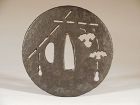
An iron, Ko-Tosho (early sword smith's) tsuba. The slightest taper from seppa dai towards rim. Pierced decoration. Purchased from Andy Quirt (ex Skip Holbrook collection) at the February 2016 Tampa show, he thought it depicted gourds. I guess the beholder might see different things. I see Japanese eggplants on leafy vine (two fruit and two leaves) supported by a bamboo trellis. An uncommon and well executed, balanced decoration. The hitsu-ana appears to be original to the tsuba. Late Muromachi. Good condition - has seen some pitting in the past but now stable (chalk it up to tekkotsu, history and character - tekkotsu attractively conspicuous on the rim), well worn to the touch, and with a good, dark patina. 2 7/8" (7.3 cm) marugata. 1/8" (3.17 mm) thick at the mimi. 3/16" (4.47 mm) thick at the seppa-dai.
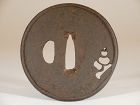
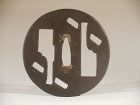
An armorer's iron tsuba, possibly for a wakizashi as it is somewhat diminuitive in size. Or perhaps more in keeping with its apparent age, an early example of a proportionately small tsuba used with an uchigatana as was first the fashion. Sukashi decoration of a conch (horagai) traditionally used for ritual practices and for signaling on the battlefield. The rare uchikaeshi-hineri rim (mimi) is significantly raised and defined almost as if to suggest a separate piece of iron around the rim (though it is one with the plate.) Though the small sukashi might suggest tosho (swordsmith), the distinct and high rim clearly indicates ko-katchushi (old armorers) work. Good condition with tekkotsu, dark patina and some inert, brown surface rust for which we are lightly applying oil when dry (we prefer not to overclean or dry out a tsuba so will not take some of the more invasive measures against only light rust.) This tsuba has an early feel - perhaps early Muromachi. 2 3/4" (7 cm) marugata. The thickness of the plate is about 1/8" (.32 cm). The thickness at the rim is about 1/4" (.63 cm)
A katchushi (or armorer's) tsuba, probably Myochin, with pierced decoration of ship's rudders (the significance being a comparison of rudders steering a ship to values guiding a Samurai's life choices.) The strong, homogenous, dense iron plate with only light tekkotsu and smooth to the touch. Dark patina. Momoyama to early Edo. Good condition: Lamination folds with openings evident on the surface of one side. Ex Skip Holbrook collection. 3 3/32" x 3 1/16" x 1/8" (7.8 cm x 7.7 cm x .32 cm)
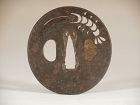
An armorer's tsuba, with very slightly raised rim on the strong, flat iron plate. Pierced decoration of a shrimp with pleasing, subtle swell along the antennae and legs (mostly on the ura.) Small, irregular brass inlays for the eyes (missing from one eye - not conspicuous.) The kogai-ana plugged with a copper rich alloy. Oval form about 2 7/8" (7.3 cm) by 2 3/4" (6.985 cm). Thickness at rim about 5/32" (.39 cm). Late 16th century to early 17th century - perhaps Momoyama period. Or possibly earlier with hitsu-ana added (though old). Good condition with varieagated hues in the dark, lustrous patina likely with extant lacquer adhering and accounting for some of the black color (note that the tsuba has an overall dark, mottled patina which our lighting doesn't adequately portray). Subtle tekkotsu evident - some old, worn pitting with the surface now smooth, almost soapy to the touch.
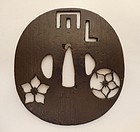
The Katchushi style of this tsuba gives it an earlier look and feel. But it is probably an Edo period work (might expect more wear on the seppa-dai or more conspicuous tekkotsu on an older example.) The thin body nonetheless resilient. Strong, sparse, decorative file marks on the vertical add to character. Adept use of the file, thin plate and slight taper toward the rim could support argument a swordsmith may have made the tsuba. Genji style mon and two five petal blossoms in fine open work (some iron detailing missing from one of the blossoms, the other with one of the open worked petals interrupting the rim.) Smaller kozuka-ana and kogai-ana flanking the seppa-dai. The surface smooth to the touch despite some old, light pitting. Possible scant old lacquer adhering closely to the surface (difficult to discern with certainty as some hard wax appears to have been applied to the surface.) Simple sukashi tsuba are considered by many to be closest to Samurai taste. Fine open work and subtle attention to detail such as the file work add to appeal. Length, 3 9/32 inches (8.33 cm). Width, 3 1/16 inches (7.78 cm). Thickness, about 3/32 inch (0.238 cm)
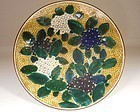
An Ao-Kutani palette porcelain deep dish in the Yoshidaya manner. Hydrangeas decoration in polychrome enamels including white, light blue-green, and dark green, blue, blue-green and aubergine in black line, all on yellow ground, a chocolate brown enamel on the otherwise unglazed biscuit rim. The number and subtlety of hues but consistent for palette is pleasing. The back with enamels including dark green on black line decoration of clouds. Kutani mark in black under yellow glaze inside the foot ring which appears to have been glazed but with the enamel rubbed along high points to the porcelain body. A couple of kiln kisses to the cloud decoration area on the back. The so called Yoshidaya type of 19th century Ao-Kutani wares is named for a merchant who revived production of a particular palette of Ko-Kutani production (of the 17th and early 18th century) adjacent to the original kilns. The current example certainly appears to be 19th century and could possibly be from the Yoshidaya kiln. Later Ao-Kutani palette production is often ambitiously ascribed to the Yoshidaya kiln which, in fact, operated only briefly from the 1820s to the early 1830s. One 3/16 inch flake (mostly to the enamel) under the rim. Otherwise good condition considering expected scratching and rubbing of the enamel. Presents well. Diameter, 11 7/8 inches (30.16 cm)
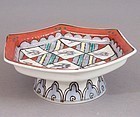
A fine, modern footed dish with red, green and yellow overglaze and with cobalt blue and manganese underglaze decoration. The hexagonal, everted rim with red border defining a cloud band around conforming hexagonal cavetto with chidori (sparrows) alternating with polychrome squares - borders of decoration all picked out with manganese (giving an iron effect but fading nicely into the blue decoration rather than spoiling it with fade to brown. The splayed foot with a cloud pattern in modern interpretation of the Nabeshima tradition. As we describe this unusual object, it should become more apparent that it is rather substantial (though small, sturdy potting) and not commercial production. The dish - top and bottom - as well as the foot retains impressed decoration and texture in the porcelain over which the decoration was added with deference... the blue glaze, for example, lightly filling the recesses of, perhaps, a hemp impression over a more broadly ridged surface and leaving the highpoints almost white. The same molded and impressed texture can be felt top and bottom of the dish and the cloud pattern on the foot can also be felt when running one's finger along the decoration. The unglazed foot rim reveals a fine, white kaolin with smooth feel to the touch. Unfortunately, though the molded and impressed decoration rather nicely retained texture, a square impressed mark inside the foot did not and offers no legible mark. We are comfortable proposing an attribution to Hajime Kato (1900 - 1968) but can not make any definitive claim and estimate accordingly. Perfect condition. Diameter, point to point, 6 3/4 inches (17.145 cm). Height, 2 1/4 inches (5.715 cm)
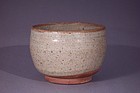
A substantial, Ayutthaya period (15th-16th century) Sawankhalok kilns alms bowl with stout, carved foot. Compare with the gift of Osborne and Gratia Hauge, and Victor and Takako Hauge to the Freer and Sackler Galleries of Asian art, Washington DC, object number S2005.280. A discovery from a Baltimore antiques center in the 90's - the present example is a bit more rustic than the museum example. The stoneware body of our smaller bowl (with somewhat less rounded sides) is burnt to an iron-orange color and the "white" glaze has a light blue-green robin's egg tinge (in contrast with the museum object's light bluish-grey tinged glaze with kiln fault.) Both exhibit the oxidized inclusions in the glaze and craze lines from the unglazed rim. Width about 5 3/4 inches (14.61cm), rim Diameter about 5 5/8 inches (14.29cm) and Height 4 1/8 inches (10.48cm)
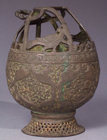
Kashmiri kangri in typical Mughal dynasty form (coal fueled warmer). Also sometimes called kanger or kangar. Used inside overcoat-like cloak (gingerly if you can imagine) or as a hand warmer if more form-fitting attire. It is difficult to imagine a metal example would have been used as such. This example may have served an alternative purpose. Metalworked examples of the form are not common - the typical materials being reed covered pottery (insulating one from burns.) Later, Raj silver services on rare occasion used the kangri form for service pieces such as creamers, sugars, tea pots, tea dumps, etc. We believe the present example should be at least early 19th century. This would make a wonderfully unusual and antique conversation piece. The whole with details crisply chiseled into the repousse decoration. The openworked, upper portion with a pair of pea fowl parading along the rim above a band of flower heads. The lower, bowl portion with similarly chiseled decoration of intricate vine and flowers among saz leaf paisleys forming a regular pattern atop a rather finely stippled ground. A flower head band again appears above a decorated, waisted foot with lattice worked, splayed rim. The beautiful verdigris patina appears to be an old, authentic patina acquired naturally over some time. We have found depth and persistence of a patina combined with an absence of metal corrosion to be a good indication of authentic, old patinas. The condition is good. A couple small areas of brighter green in the patina suggest a relatively high copper content. Color consistent with this premise shows from a minuscule 1.5mm point of disturbed patina on the side and some more along the foot rim. A bend along the foot rim suggests a commensurate degree of malleability. It could be used with potpourri or as a stand alone decorative work of art. Height: 6 5/8 inches (16.8cm)
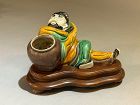
A Chinese sancai (three color) decorated biscuit figure of Li Bai - an historical Chinese poet of the Tang dynasty. The colors, on famille verte palette, adorn the figure in repose, leaning on a wine pot. The group functions as a brush washer that would have been used on a scholar’s table (appropriate to the subject). Probably Kangxi period - late 17th century. With later stand. Length, at longest span, about 6 inches. Condition is good for the period and intended use, with only a small chip on the wine pot and on the end of an object (probably a brush case) in his right hand.
Pair of Niō guardian figures in forbidding pose. Vigorously sculpted wood with remnants of distressed polychrome pigments. Later Edo period - probably first half of the 19th century. The sculptures are in fair, presentable condition though polychrome pigments are distressed and loose. With some checking and movement of the wood to be expected, there is a larger crack in the lower half of one figure. Standing about 22 inches including the bases, add another few inches for the blade held high by one of the figures.
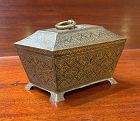
A finely worked Koftgari damascene gold inlay on steel decorated casket form box. Possibly from Sialkot but certainly from the Kashmir area of North India at the time (now Pakistan). 19th century. 5 1/8 inches length, 3 1/3 inches wide, 3/3/8 inches high - also with ring handle on boss fitted to the top. Good condition (key not retained).
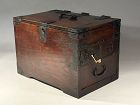
An Edo period kake-suzuribako (scroll calligraphy box). Iron hardware all in place. Lock face and key but lock works mostly gutted. Original tray with liner retained. Wood surface naturally distressed from use but with expected, even patina with all the accompanying charm. A smoothly finished zelkova (keyaki) may be used for the primary wood, and sugi (cedar) for the aromatic secondary wood. Length, 14 1/4 inches. Depth, 9 1/2 inches. Height, 9 3/4 inches.
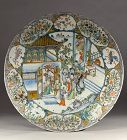
A finely decorated Chinese famille verte porcelain plaque. Exuberant and well decorated scene of figures in architectural and garden landscape, surrounded by a band of flower, bird and precious objects adorned reserves. An inscription on the verso. Originally a component in a chair, stool, table or screen, now entirely useful as a trivet or decoration (or perhaps to complete a rare early furniture item in need of an inset). 18th century. Good condition, with some glaze wear or fritting around the rim. 13 3/4 inches diameter.
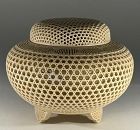
A very finely made Satsuma alms bowl form kōro (incense burner). Clear glaze pooling to a light, warm green tea tone over the off-white earthenware body. The reticulated surface of the vessel enclosing a smaller, solid surface to hold burning incense (a technical feat demonstrating the imagination and skill of the potter). Relief key fret band around the rim and comb pattern around the base. Similar relief decoration on three shaped feet. The cover a single reticulated surface allowing essence from the incense to pass. An unglazed ring on the bottom, centered within the three feet, surrounding a smooth surface where at least two incised kanji characters are almost legible under the glaze near one of the feet. With fitted wood box, the cover inscribed ‘Satsuma [?] kiln, basket weave incense burner’ and signed ‘Gyokumeizan’ (a celebrated line of ceramists), each with seal stamps. “Satsuma” is the old name of the province and the namesake of its ceramic tradition. We are not sure if “Satsuma” on the box is reference to a municipality or a market enterprise (as the trailing kanji character could be the same for ‘city/town’ or for ‘market’). We believe this tour de force to be about Taishō era. Condition is good. The reticulated work of the top has one tiny surface loss which does not disrupt the pattern and is barely discernible. The side of the vessel has one spot of thicker glaze softening the definition of the reticulation with opacity at that point. Diameter, about 5 inches. Height (covered), about 4 inches.
Ex collection, Robert Berg (Ichiban Antiques)
Ex collection, David Callens (Meiji Bijutsu)
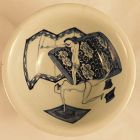
A well made 19th century Japanese porcelain haisen (sake up rinser on stem foot). Rare Shunga decoration depicting a bondage scene within the bowl. The manner of the painted decoration in comic fashion similar to that found on some shunga makimono. Shunga paintings and prints are rare enough but encountered. Edo period porcelains with shunga decoration are exceedingly rare. Good condition. Height, 4 1/2 inches. Diameter, 6 3/4 inches.