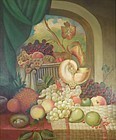
A 19th century American folk art painting. Oil on canvas. Table top still life of bountiful agricultural harvest and a pineapple likely from port trade (pineapples were popular import produce in 19th century port cities and much can be read of pineapples in American tradition and design - most notably relating to hospitality.) Relined - otherwise good, clean and bright condition. Stretcher dimensions 30 1/2 inches x 25 1/4 inches. We acquired this in the late 90s from a long time Georgetown period furniture dealer (and Trocadero member) who had this in his own dining room for years. We have, also, enjoyed it in ours since but it is now time to lighten up as we prepare for a distant move.
Spoils of Time
$4,700
This is too heavy and precarious to ship by standard mail or delivery options. Buyer need arrange with a shipper in our area.
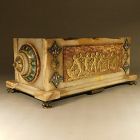
A substantial 19th century French jardiniere. The shaped form of onyx with mellow patina. Each side with rouge marble panels supporting ormolu. The end panels round, also with champlevé and bronze doré. the side panels with cherubs decoration flanked by champlevé and bronze doré design elements. The jardiniere raised on paw doré feet. Wear on surfaces, edges and corners from use; one flanking bronze boss missing left of one of the larger ormolu side panels; but overall good condition.
Length at various points ...
End to end of the decorative bosses at either end, almost 20 inches.
End to end of the base, 17 1/4 inches.
Corner to corner of the main compartment, 15 1/2 inches
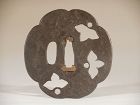
A katchushi mutsu-gata sukashi tsuba. The six lobed, thin plated armorer's tsuba with good tekkotsu and with openwork decoration was described by Skip Holbrook (ex collection) as Saotome made and depicting three birds. The Saotome were a line of armorers (katchu) turned tsuba makers. But I think a case could be made for the sukashi decoration being a wabi-sabi flower bloom or possibly paulownia leaves (rather than awkward looking "birds".) Use of the paulownia (kiri) mon could suggest Yamakichibei as those tsuba makers, from Owari, were outfitting swords for the Oda and the Toyotomi - the latter using the kiri ka-mon. Good condition. 2 7/8 (7.3 cm) inches x 2 13/16 (7.14 cm) inches
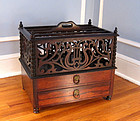
A fine 19th century classical rosewood canterbury. The four compartments separated by three rail and stile partitions with handle, enclosed by openwork lyre sides and turned corner posts with finials, all over two drawer case raised on turned feet. Wonderfully appropriate for a period music room. The two drawers likely cost the patron a pretty penny in the period and are not commonly encountered. Secondary woods (exhibiting only hand rendered kerf marks) include red cedar and chamfered poplar for the drawers, and red cedar and knotty pine for the case. Note the darker oxidation (as expected) on the exposed lower drawer bottom. Probably American, inspired by Regency design. Compare with Neal's 2005 Winter Estates Auction lot 261 which lacked case and drawers. Very good condition save some rosewood veneer loss on one side lyre (see third enlargement - a minor consideration easily restored - we will not.) This will ship oversized or by special delivery service at buyer's expense. Length 20 1/2 inches (52cm), Height 18 inches (45.7cm), Depth 14 1/2 inches (36.8cm).
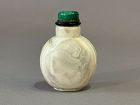
A fine, small, late Qing dynasty agate snuff bottle. Mostly shades of white with subtle warm earth tones appearing within variegated structure. Well defined foot, very slightly concave top, well hollowed interior. A malachite stopper top. Ex Don Elder. 2 inches high bottke only, 2 1/2 inches with the stopper
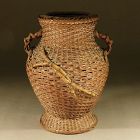
A Japanese woven bamboo reed ikebana basket. Of small size and fine work. Having handled a good number of ikebana baskets over time, this one strikes us as quite sophisticated. Of baluster form, meticulously consistent woven pattern, defined foot and rim, sparse and well balanced decorative intertwined bamboo shoots across the face, and confidently woven handles. Excellent condition. Height, 8 inches.
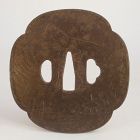
A well forged, handsome mokume tsuba in mokko-gata form with katakiri-bori landscape decoration on both the omote and ura. The mokume grain is large and well controlled reminding one of ayasugi hada. In fact, this tsuba is indeed a tosho (swordsmith's) tsuba, being made by [Kai Ju] Kiyonaga and dated the third year of Bunkyo (1863) believed to be the same as KIY 298 referenced in Hawley's, Japanese Swordsmiths. Our angled, side view photographs more accurately portray patina and color as well as the mokume grain. Good condition. 3 5/8 inches (8.4 cm) X 3 3/8 inches (8.1 cm) and 7/32 inches thick (.55 cm) at the raised mimi and about 1/8 inch (.32 cm) thick at the seppa-dai. The raised mimi and no taper across the plate are atypical of traditional tosho tsuba. But the present example being 19th century, and toward the end of the Edo period, allows latitude for creativity. Ex Arnold Frenzel collection. If both sensitivity and strength are conveyed in the smith's blades as they are in this tsuba, I would be tempted to acquire one of his swords.
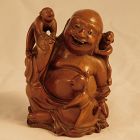
A good Chinese boxwood carving of Budai. Three children clamor over him. A bat appears on his right hand. Bone and horn inlays detail his eyes and teeth. Rich, mellow old patina. Nice grain figure in places. Late Qing to early Republic. Ca 1900. Very good condition with typical minor distress checks in the old hardwood surface. Remnants of old label. Height, about 4 5/8 inches high.
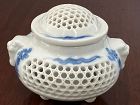
A Hirado blue and white porcelain censer with pierced lattice work cover and sides. Lion masks in relief on opposing sides. Decoration of aromatic flowers and wisps of burning incense. Three feet elevate the censer above surfaces. Early Showa period. Good condition. Lion mask to Lion mask nearly 4 inches in length. Height, covered, just over 3 inches.
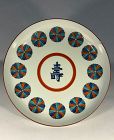
An unusual and fun Kakiemon dish. Decoration in underglaze blue, persimmon red, teal and yellow-green enamel. The rim meticulously lined with chocolate brown enamel resist before adding the glaze. A central ‘Ju’ character similarly encircled with a band of persimmon red enamel resist on the biscuit before glazing. The porcelain surface exhibits an early feel (I think of it as a fine ‘pear skin’ texture) that later production doesn’t achieve. The ‘Ju’, or ‘Toshi’, kanji character is a celebratory wish here for longevity. This would not be unusual in context of a superior’s or esteemed’s birthday. There is some precedent for longevity motif from Chinese doucai porcelains, with stylized ‘Shou’ character (the same as for ‘Ju’), of Qing dynasty China (from which much decorative arts influence has conveyed to Japan over the centuries). The surrounding chrysanthemums number twelve, each with 12 main and 12 overlapped petals (24 petals each). The main imperial line would use 32 (16 petals and 16 overlapped petals). The use in this case could relate to a lesser line of the family, a feudal lord or it may be simply an exuberant expression. A group of five kiln spurs appear within the foot revealing the well refined kaolin retaining light, fine grit from the kiln. Edo period, first half 18th century. A small round chip just inside the rim, otherwise good condition (an excellent candidate for 'kintsugi'). Diameter, about 9 1/2 inches
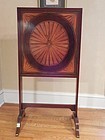
An unusual and dramatic firescreen abattant. It reminds me of some of the smaller, New York classical parlor furniture I've seen in Southern house tours with late Federal drawing and music rooms furnished with pieces imported by successful merchants - almost, but not quite, over the top in their design yet direct in their function. So an argument could be made for high, New York city style. And the inlaid oval in the center, with pie crimped edge, is reminiscent of some New England work. The passive function is that of a firescreen and explains the distress to the side with inlay which likely faced the fireplace (rather than the upholstered side.) The "surprise" is the enclosed work area with the hinged top dropping to provide a writing surface (abattant [fr], "put horizontal") below the interior fitted with letter or document slots (only the back one of three dividing slats remaining - evidence of two more, and three segments which would have divided at least one of two lateral slots into three sections.) Perhaps because of the narrow profile, there appears to be no secondary wood under or behind any of the solid mahogany. Condition is quite good considering the likely heat exposure as a firescreen and probable stress to the hinged top which relies upon the case as a counter-stop. We had distress to the inlaid surface evened out, filled and finished - disturbing old finish as less as possible - to make it presentable for the decorator yet acceptable to the collector. We left the old upholstery (possibly original) alone for the next steward to decide. Our restorer (specializing in period furniture) had also never before encountered this design. Our photographs illustrate the character of the old, now serviceable inlaid surface. Ca 1800 - 1810. Height, about 42 3/4 inches. Width, about 21 5/8 inches (about 22 1/4 inches wide at the trestle base).
This firescreen abattant may be inspected at The Antique Center at Historic Savage Mill, Maryland
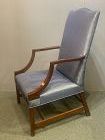
American Federal period mahogany lolling chair. Sparse, fine line inlay decoration. Late 18th century. Good condition. Seat height a little low from wear to legs. Seat height about 15 inches. Back height about 40 inches. Width roughly 24 inches.
This chair may be inspected at The Antique Center at Historic Savage Mill, Maryland
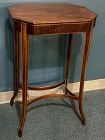
A Federal sewing table of elegant form. Mahogany legs and mahogany veneered skirt - both with string inlay. Stylized, bentwood stretchers with mahogany veneer bracing the graceful, tapering legs. The top a later replacement and the key escutcheon without a lock mechanism. Early 19th century and later. Refinished. Serviceable condition. Height, 31 1/4 inches. Width 18 5/8 inches. Depth, 14 3/8 inches.
This table may be inspected at The Antique Center at Historic Savage Mill, Maryland
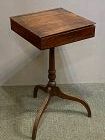
A late Federal work table of elegant proportion and lines. The narrow, almost square top on turned pedestal with three reeded spider legs. Original surface with pleasant patina. Good condition. Height 31 inches, width 16 3/4 inches, depth 15 3/4 inches.
This table may be inspected at The Antique Center at Historic Savage Mill, Maryland
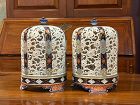
A very rare pair of finely modeled and decorated Imari reticulated, lantern form porcelain candle domes. Blue underglaze and polychrome enamel decoration with very pale celadon pooling in the clear glazed areas. This extraordinary find is made only more so by coming in a pair. The only similar objects I initially find include an Hirado censer (in two parts) in the Los Angeles County Museum of Art (M.2003.154.25a-b) and another, “Seto” example in the Victoria and Albert Museum (172&A-1877), both early 19th century. I think one will not find another. It is not improbable that the blanks, well decorated in Imari palette, may be Hirado production by special order. This is consistent with the intricate open worked flowering vine decoration as well as the feel of the unglazed biscuit around the bottom aperture. A cobalt blue band with apparently Japanese family Mon in white adorns the bottom above three, shaped feet. With this, it becomes less clear whether these were intended for domestic consumption or (more likely) for export. 19th century. One is in very good condition. The other is also fully serviceable and sound though with an old stress line on the bottom rim (see enlargement views). That one is 11 1/4 inches high. The other is 11 1/2 inches high.
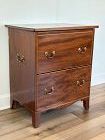
This Federal lift-top chest with lower drawer reminds of southern American sugar chests. With proportions being comparable, this low-height chest is more formal with mahogany, on the small side and without a divided top compartment. With yellow pine secondary wood, the frame is raised on french feet. Sourced from Middleburg, Virginia. The line of inlay across the front of the lift-top is old but not original (old hinge marks showing that the top was reversed back to front at some point). The other inlay was replaced by us to fill routing where inlay (probably also added later) was missing. The front pulls were added to replace cheap Chippendale style brasses which weren’t appropriate. We’ve used it as a cellarette. Wine bottles fit perfectly in the drawer (as you can see from one of our pictures). Other practical uses may have been as a silver chest or a campaign chest. The top compartment with lift top is likewise well proportioned to take accessories, wine bottles on their side and other, smaller bottles standing upright. Good, restored condition. Height, 27 7/8 inches. Width, 23 3/16 inches. Depth, 17 1/16 inches.
An appointment would be necessary to inspect this chest
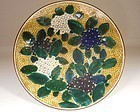
An Ao-Kutani palette porcelain deep dish in the Yoshidaya manner. Hydrangeas decoration in polychrome enamels including white, light blue-green, and dark green, blue, blue-green and aubergine in black line, all on yellow ground, a chocolate brown enamel on the otherwise unglazed biscuit rim. The number and subtlety of hues but consistent for palette is pleasing. The back with enamels including dark green on black line decoration of clouds. Kutani mark in black under yellow glaze inside the foot ring which appears to have been glazed but with the enamel rubbed along high points to the porcelain body. A couple of kiln kisses to the cloud decoration area on the back. The so called Yoshidaya type of 19th century Ao-Kutani wares is named for a merchant who revived production of a particular palette of Ko-Kutani production (of the 17th and early 18th century) adjacent to the original kilns. The current example certainly appears to be 19th century and could possibly be from the Yoshidaya kiln. Later Ao-Kutani palette production is often ambitiously ascribed to the Yoshidaya kiln which, in fact, operated only briefly from the 1820s to the early 1830s. One 3/16 inch flake (mostly to the enamel) under the rim. Otherwise good condition considering expected scratching and rubbing of the enamel. Presents well. Diameter, 11 7/8 inches (30.16 cm)
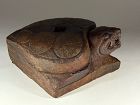
A rare Korean folk art, turtle form, carved wood candle stand base. Hints of once vibrant polychrome stain or paint decoration accentuate parts of the turtle’s shell, front feet, face, eyes and apparently teeth. So perhaps it depicts a mythical turtle. Subsiding water is suggested by a decorative detail bridging the top and bottom of the beak tip of the turtle’s mouth. An aperture of square section on the turtle’s back supported the candle holder. Joseon dynasty: 19th century or earlier. Good, well used condition with rich patina. Length, 12 1/4 inches. Width, point to point , 11 1/2 inches. Height, from floor to beak, 4 3/4 inches